A Final Bow in Hyrule: Why the Open World Era Deserves a Top-Down Swan Song
As I stand here in 2026, gazing back at the seven-year reign of the Nintendo Switch, the air in Hyrule feels different. The winds of change have been blowing since the announcement of the Switch's successor and the delightful curveball that was The Legend of Zelda: Echoes of Wisdom. The era of sprawling, physics-driven wilderness—the era defined by Breath of the Wild and Tears of the Kingdom—feels, for all its monumental success, like a chapter that has reached its final, glorious page. Nintendo's own creators have whispered that this particular Hyrule's potential is exhausted. Yet, in my heart, a quiet, persistent question lingers: must we say a complete goodbye? Is there not room for one final, intimate farewell, a chance to see this beloved world through a different, more nostalgic lens? What if the grand, open-world saga could have a poignant, top-down epilogue?
A Legacy Built for Transformation
The very soul of these modern Zelda games, I believe, is uniquely suited for such a metamorphosis. Look at their art—the stylized, expressive character models of Link, Zelda, and the champions. They are not bound by hyper-realism; they are timeless cartoons, vessels of emotion. Translating them into a charming, chibi-inspired aesthetic for a top-down adventure would not be a diminishment, but a celebration. We've seen this magic before, haven't we? The Wind Waker's bold, cel-shaded vision didn't end with its own voyage; it gracefully sailed into the portable sequels and even sprite-based adventures like Four Swords Adventures. The precedent is etched into the franchise's history: great art styles are meant to be explored from every angle.
The Blueprint is Already There
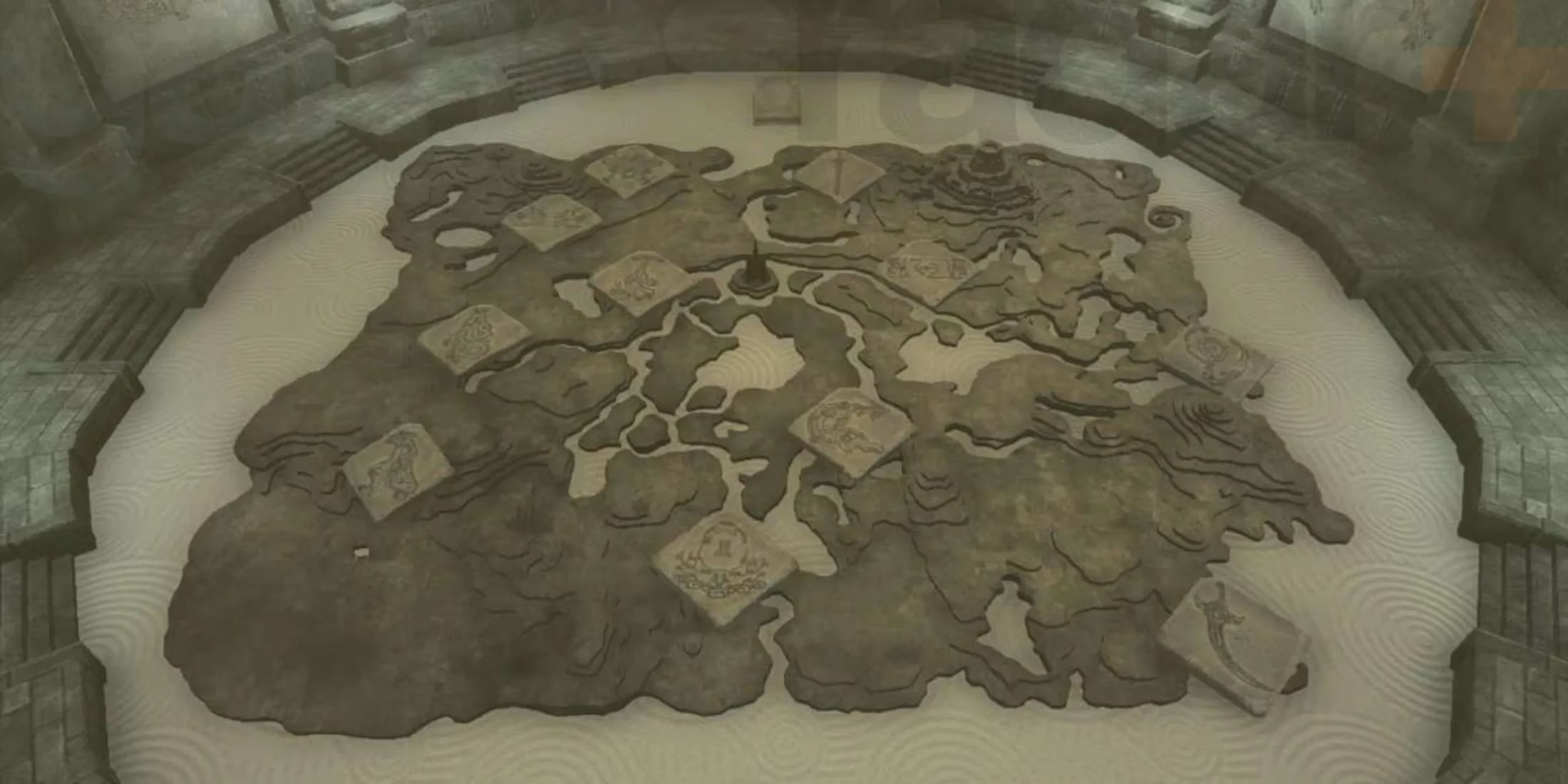
Some may wonder, how could the vast, vertical playgrounds of BotW and TotK possibly fit into a classic grid? But I find the connection more profound than it seems. Isn't the foundational structure of this Hyrule—with its castle at the heart, its villages dotting the landscape, and its elemental regions holding ancient secrets—the very blueprint of classics like A Link to the Past? The map, in its essence, is already a classic Zelda map, just rendered in an unprecedented scale. A top-down reinterpretation wouldn't need to shrink the spirit, only reframe it. Imagine navigating a compact, dense version of this world, where every screen transition holds a secret, and the landmarks we climbed and glided from become intricate, interconnected puzzles on a single plane.
The gameplay practically writes itself with this fusion:
-
Dungeons Reimagined: Picture the Divine Beasts or the Temples of TotK, not as vast, open-ended complexes, but as tightly designed, multi-floored labyrinths in the classic style. The Rune/Ultrahand/Zonai device mechanics could be brilliantly abstracted into a new core item—a tool that lets you manipulate the environment in 2D, much like the wall-merging mechanic in A Link Between Worlds revolutionized top-down exploration.
-
A New Quest for Link: With Zelda finally wielding the Triforce of Wisdom in her own starring role, where does that leave our Hero of the Wild? A smaller-scale, top-down adventure would be the perfect interim journey for him. It could explore lingering threads, perhaps finally revealing the full fate of the enigmatic Zonai race, a mystery still whispering on the wind after Tears of the Kingdom.
The Most Important Reason: A Bridge Between Eras
Yet, beyond the practicalities and the charming possibilities, there lies the most compelling reason of all—one that speaks to the very heart of the Zelda community. For years, a chorus of fans has lovingly lamented the shift away from the compact, hand-crafted worlds and linear, themed dungeons of the past. Their voices weren't mere resistance to change; they were a testament to the unique, irreplaceable value of that classic formula. So, what if this proposed game was an olive branch, a grand experiment? What if modern Nintendo applied its boundless creativity and technical prowess not to expanding boundaries further, but to perfecting the classic formula within its most successful modern setting?
This would be more than a spin-off; it would be a dialogue between Zelda's past and its revolutionary present. It would answer a fundamental question: Can the soul of classic Zelda—the focused adventuring, the dungeon-centric progression—thrive when painted with the lore, characters, and aesthetic of the open-world era? The Hyrule of Breath of the Wild and Tears of the Kingdom is the perfect, living stage for this test. It's a world we know and love, ready to be rediscovered.
| Era | Core Design | Potential Fusion in a Top-Down Game |
|---|---|---|
| Classic Zelda (e.g., ALttP) | Linear dungeons, compact overworld, item-gated progression. | The structure: themed dungeons unlocking new areas of a condensed Hyrule. |
| Open-World Zelda (BotW/TotK) | Systemic physics, vast nonlinear exploration, rune-based tools. | The mechanics: a single, versatile tool (inspired by Ultrahand) that enables creative 2D puzzle-solving. |
| Artistic Legacy | Pixel art & detailed sprites. | The aesthetic: chibi-fied, expressive models from BotW/TotK in an isometric view. |
In the end, as we all eagerly await the next grand, 3D evolution of the series on new hardware, this idea feels like a necessary closure. It's a chance to honor the monumental impact of the Switch's Zelda games not with a distant remaster, but with a creative reinterpretation. It's a gift to the fans who miss the click of a locked door opening, the satisfaction of a perfectly sequenced dungeon, and the intimate scale of a world that fits in the palm of your hand. Before we fully move on, let us have this final, poetic look back—not from a mountain peak, but from a bird's-eye view, where every river, forest, and ruin tells a familiar story in a wonderfully new way. The era may be ending, but its echo deserves to resonate in every form the series has ever known.
Comments